.png)


Exploring the Cutting-Edge Features of the XSEL2 for Advanced Motion Control Applications

One Controller. Eight Exceptional Functions. Endless Possibilities.
Motion control technology continues to evolve, pushing the boundaries of what automated systems can achieve. The XSEL2 stands out as a powerful solution designed to meet the demands of complex, multi-axis control environments. This blog post highlights the key features of the XSEL2, demonstrating how it supports up to eight axes simultaneously and integrates advanced functions to enhance performance and flexibility in industrial applications.
Controlling Up to Eight Axes at Once
One of the most impressive capabilities of the XSEL2 is its ability to control up to eight axes simultaneously. This feature allows for complex automation setups without the need for multiple controllers. For example, a recent demonstration video shows the XSEL2 managing a four-axis IXA Scara robot alongside a two-axis cartesian system and there is still capacity for additional devices such as a ROBOCylinder and an ELECYLINDER, illustrating the system’s scalability and flexibility.
This multi-axis control capability simplifies system architecture, reduces hardware costs, and improves synchronization between different motion components. It is ideal for applications requiring coordinated movement across several devices, such as assembly lines, packaging machines, and robotic handling systems.
Function 1: CODESYS Equipped for Flexible Programming
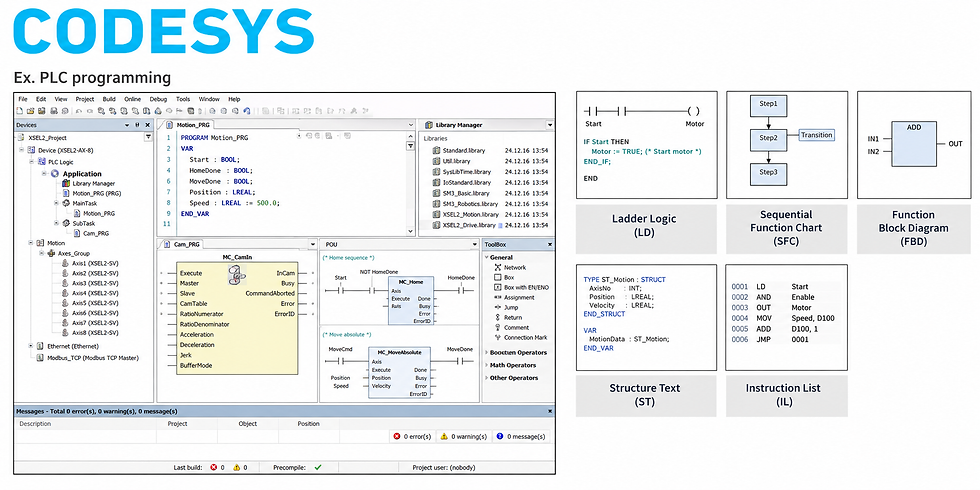
The XSEL2 comes equipped with CODESYS, a widely used development environment for programmable logic controllers (PLCs). This integration allows users to program motion control tasks using familiar IEC 61131-3 languages, including ladder logic, structured text, and function block diagrams.
For example, a user can create a custom motion sequence for a Scara using structured text, then simulate and debug the program within CODESYS before deployment. This flexibility reduces development time and enables precise control tailored to specific application needs.
Function 2: OPC UA Server Included as Standard

The XSEL2 includes an OPC UA server as a standard feature, enabling seamless communication with other industrial devices and systems. OPC UA is a platform-independent, secure communication protocol widely adopted in Industry 4.0 environments.
With this server, the XSEL2 can exchange real-time data with SCADA systems, MES platforms, or cloud services. For instance, an operator can monitor the status of all eight controlled axes remotely, receive alerts for maintenance needs, or adjust parameters on the fly, improving operational efficiency and responsiveness.
Function 3: Master Equipped with EtherNet/IP Scanner

EtherNet/IP is a popular industrial network protocol, and the XSEL2’s built-in EtherNet/IP scanner allows it to act as a master device on this network. This means the controller can manage and communicate with multiple EtherNet/IP-compatible devices, such as sensors, actuators, and other controllers.
In practice, this feature enables integration into existing EtherNet/IP networks without additional hardware. For example, a packaging line can use the XSEL2 to coordinate motion with vision systems and conveyor controls, all connected via EtherNet/IP.
Function 4: Preservation with Predictive and Preventive Maintenance

The XSEL2 supports preservation functions that include predictive and preventive maintenance capabilities. These functions monitor the health and performance of connected devices, identifying potential issues before they cause downtime.
Predictive Maintenance Functions
The controller continuously monitors: Fan rotation speed, motor overload status, internal system conditions
This allows maintenance teams to detect issues before failures occur.
Preventive Maintenance Functions
The XSEL2 also tracks: Capacitor life prediction, temperature history, operating time, motor current values, present positions, travel cycles, running distance
This enables data-driven maintenance scheduling.
Example
Instead of waiting for a machine failure: Maintenance teams receive early warnings, components can be replaced proactively and downtime won't be unexpected
This improves: Machine uptime, production reliability, spare parts planning and overall equipment effectiveness (OEE)
Actuator Recognition Function
Actuator information can now be confirmed with teaching tools. There is also an area where customers can freely write information to the actuator.
Function 5: Library of Supported Function Blocks

The controller offers a comprehensive library of function blocks that simplify programming and expand functionality. These blocks cover common motion control tasks such as positioning, speed control, interpolation, and synchronization.
Users can combine these blocks to build complex motion sequences without starting from scratch. For example, a function block for cam profiling can be used to create smooth, coordinated movements between multiple axes, essential for applications like packaging or textile machinery.
Function 6: ELECYLINDER Connection Supported

The XSEL2 supports direct connection to ELECYLINDER devices, which are electric actuators designed to replace pneumatic cylinders. This support allows for precise control of linear motion with the benefits of electric actuation, such as energy savings and reduced maintenance.
In a practical setup, the XSEL2 can control an ELECYLINDER to perform tasks like clamping, pressing, or lifting with high accuracy and repeatability. This integration streamlines system design by eliminating the need for separate controllers or interfaces.
Function 7: Support and Teaching Tools Included
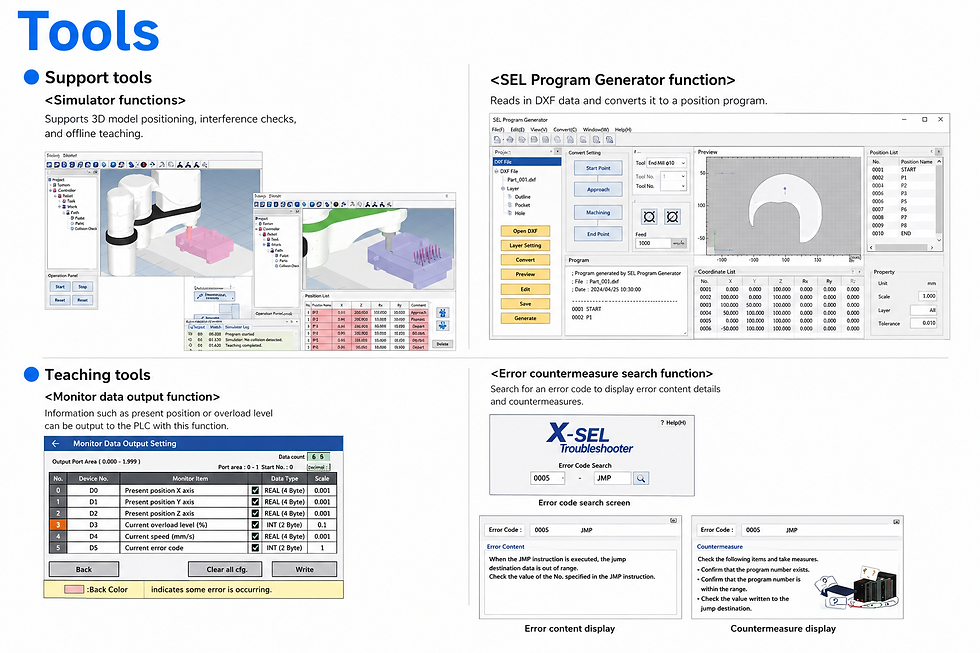
To facilitate setup and operation, the XSEL2 provides various support and teaching tools. These tools help users calibrate devices, teach positions, and fine-tune motion parameters directly through the controller interface or connected software.
For example, an operator can use a teaching pendant or software tool to manually move a robotic arm to desired positions, which the controller then records for automated playback. This feature reduces commissioning time and improves ease of use.
Function 8: Superb Functions for Enhanced Performance

Beyond the core features, the XSEL2 includes several advanced functions that enhance overall performance. These include high-speed interpolation, electronic cam control, and multi-axis synchronization with minimal latency.
Such capabilities enable smooth, precise motion even in demanding applications like semiconductor manufacturing or high-speed assembly. The controller’s architecture ensures reliable operation under heavy loads and complex motion profiles.
The XSEL2 offers a comprehensive set of features that make it a strong choice for advanced motion control applications. Its ability to manage up to eight axes simultaneously, combined with flexible programming, network integration, and maintenance support, provides users with a powerful tool to build efficient and reliable automation systems.


First store, bedding niche, and every supplier photo had moire because they'd been shot off a screen. Asking for the originals fixed it for free — try that first. The fix here for the ones nobody can reshoot.